

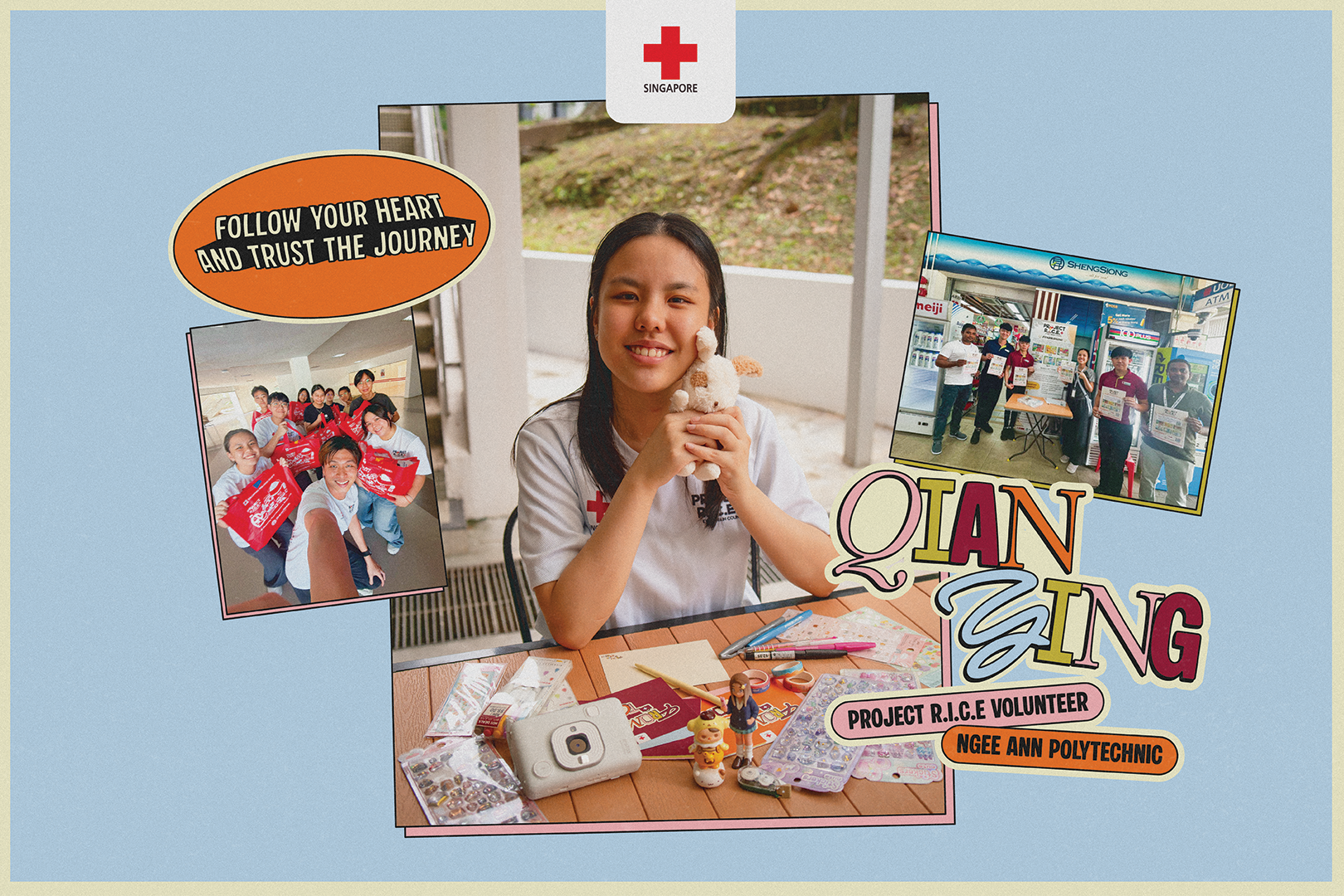
This Youth Day, nursing student Soh Qian Ying reflects on how Project R.I.C.E.+ showed her that beyond just giving back, humanitarian work is about the power of communities coming together.
After completing her O-Levels, Soh Qian Ying found herself facing a question that many young people can relate to: What comes next?
Although she is still exploring where her future might lead, there is one thing the 20-year-old is sure of — she wants to make a positive difference in the lives of others.
The desire eventually led her to pursue nursing at Ngee Ann Polytechnic (NP). But for Qian Ying, serving others extends beyond the classroom.
When the opportunity to join the Red Cross Youth’s Project R.I.C.E.+ came along through NP, she saw it as another chance to live out that same purpose.
“What drew me to Project R.I.C.E.+ was the opportunity to be directly involved in supporting the community. More importantly, I wanted to step out of my comfort zone and contribute to something larger than myself.”
Looking back, she is glad she took the leap of faith.
As her first large-scale humanitarian project, Project R.I.C.E.+ opened her eyes to the immense amount of planning, coordination and teamwork that goes into supporting the local vulnerable communities. Behind every food bundle are months of planning, fundraising and collaboration between volunteers, donors and community partners.
More Than Just Numbers
During the fundraising phase, Qian Ying found herself watching the donation figures climb on screen. At first, they were just numbers on a screen.
But when she stopped to consider what those numbers represented, it dawned on her these are not mere statistics.
“The donations go towards approximately 46,000 food bundles for families in need. When you think about it, that’s not just 46,000 bundles. That’s thousands of families receiving essential food items, thousands of meals on dining tables, and thousands of people knowing that their community has not forgotten them.”
In that moment, the campaign became more than just a fundraising effort.
“Even though my own contribution may seem small, collectively we’re able to make a difference on a much larger scale.”
The experience also reinforced something she has come to believe through both nursing and volunteering — that helping people is not always about solving every problem. Sometimes, it is simply about showing up, listening without judgement and treating them with dignity.
Over time, volunteering changed the way she sees her own role in the community.
Before joining Project R.I.C.E.+, volunteering was just a way to help those in need. But now, it is about contributing towards a larger purpose.
“Project R.I.C.E. showed me that creating positive change isn’t just the responsibility of organisations or community leaders, but a shared effort where everyone has a role to play. From fundraising and logistics to packing food bundles and encouraging others to volunteer, every role matters.”
Meeting families supported through Project R.I.C.E.+ deepened that perspective.
Rather than defining them by their challenges, Qian Ying came to admire their resilience, determination and unwavering care for one another.
“Every family has a unique story, and often there are struggles we cannot see from the outside. Sometimes what people need most is not judgement or pity, but respect and genuine human connection.”
Where Change Begins
Those experiences also reshaped her understanding of humanitarian work. Many people assume it is simply about packing food or volunteering at one-off events.
“But humanitarian work goes much deeper than that. It’s about understanding people, identifying needs, and finding sustainable ways to support communities.
More importantly, she hopes more young people will realise they do not need to wait until they are older or more experienced before they can make a difference.
“I realised I can start now, with the skills and opportunities I already have.”
Looking back, she believes the biggest lesson Project R.I.C.E.+ taught her is that meaningful change happens when ordinary people choose to step forward, contribute what they can, and inspire others to do the same.
“Young people shouldn’t underestimate the impact we can make. We may not have years of experience, but we have enthusiasm, creativity and a willingness to learn. When those qualities are paired with genuine desire to serve, we can make a meaningful difference in the community.”